
St. Louis fire truck loses 125-foot aerial nozzle during North City blaze
A water-carrying assembly detached from a reserve ladder truck during a second-alarm response, prompting a multi-week investigation into the structural failure.
By Garrett Lindqvist ·
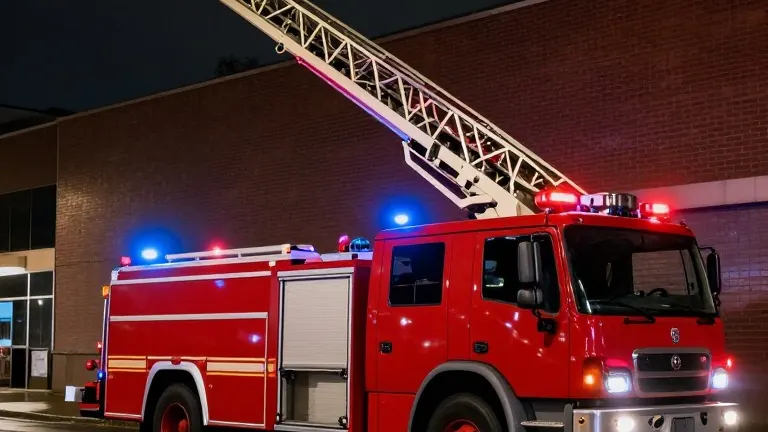
St. Louis Fire Chief Dennis Jenkerson confirmed that a water-carrying pipe and nozzle assembly detached from a ladder truck during a fire response in North City on Saturday night. The equipment failure occurred while a firefighter was positioned at the top of the extended ladder.
The incident took place during a second-alarm fire at a vacant church located at the intersection of Kingshighway and Terry. Hook and Ladder 6, assigned to the 6th District, was among the first units on the scene. The on-scene commander requested an aerial waterway as the fire intensified, leading the crew to raise the ladder and connect the water supply.
The truck involved is a 2009 Smeal aerial ladder that serves as a reserve unit for the department. According to Chief Jenkerson, the firefighter operating the stream reported seeing the truck assembly begin to move away from the right side of the ladder just as water flow started. The crew immediately shut down the operation, and the master stream nozzle fell from the truck.
No personnel were injured in the incident. Chief Jenkerson stated that the firefighter was secured with a safety harness, standard procedure for operations at heights up to 125 feet. The harness prevented the firefighter from falling when the assembly detached.
The department’s shop and its deputy chief in charge of equipment photographed the scene, and a third-party investigator is currently examining the truck. Initial findings indicate no rust or breakage in the ladder itself. The failure appears to be isolated to the truck assembly that holds the aerial waterway, possibly due to sheared or loose bolts.
The investigation is expected to take between one and two months. Investigators will determine if the equipment failed mechanically or if there was an error in the operational setup. Chief Jenkerson noted that many questions remain unanswered regarding the specific cause of the detachment.
The reserve truck has been taken out of service, and the department is utilizing another reserve unit in its place. Since the incident, the department’s shop has inspected all 125-foot aerial ladders, checking assemblies and bolts. No issues have been found in the other units so far.
Aerial ladders are inspected by third parties every five years to check structural integrity, outriggers, and the mainframe. The truck involved in Saturday’s fire recently passed this inspection. Equipment is tested according to NFPA standards, including X-rays for cracks and rusting.
This type of equipment failure is rare in the United States but has occurred previously. Following a fatality in 2008, the National Institute for Occupational Safety and Health issued a safety advisory noting 10 documented instances of similar failures. Chief Jenkerson cited his own experience with a platform malfunction early in his career, noting that mechanical equipment can fail despite safety protocols.